
Most people think influence is public, loud, and easy to spot. We think the opposite is often true. Influence starts in quiet places. It appears in the way we speak, the trust we build, the choices we repeat, and the spaces where others listen when we enter the room.
When we map our personal sphere of influence for 2026, we are not trying to look bigger than we are. We are trying to see clearly. That changes everything.
Your sphere of influence is the set of people, spaces, and decisions your presence can shape in a real way.
A few years ago, many of us believed influence was limited to job title, money, or visibility. Then we noticed something else. A person with no formal authority could calm a team in crisis. A parent could shift the emotional tone of a whole home. One honest conversation could alter a friendship, a project, or a future step. Influence was there all along. It just had not been mapped.
What influence really includes
Personal influence is not only about getting others to agree with us. It includes how we affect mood, trust, action, direction, and standards. It can be direct or subtle. It can help or harm. That is why mapping it matters.
We cannot guide what we refuse to see.
In our experience, a useful map has three layers:
- People we affect often, such as family, friends, clients, peers, and team members.
- Spaces we shape, such as meetings, online groups, classrooms, homes, and community circles.
- Decisions we can sway, such as hiring, spending, habits, shared plans, and conflict outcomes.
This already changes how we think. We stop asking, “How much influence do I have?” and start asking, “Where does my influence already operate?”
Why 2026 asks for a clearer map
The next year will not reward scattered effort. It will reward coherence. Many people are entering 2026 with more noise around them, more mixed loyalties, and less inner clarity. That means our influence can become confused if we do not define it.
We also know that influence is not random. Research with 1,141 participants across nine samples showed that a person’s sense of power tends to stay moderately consistent across relationships, while also being shaped by social position and traits such as dominance, as seen in this University of California, Berkeley study. That means our influence has patterns. If it has patterns, it can be mapped.
Culture also changes influence. An international study on communication, culture, and social distance found that country of origin and social distance shape how people respond to others. We think this matters even in daily life. The farther we are from a person emotionally, socially, or culturally, the less natural our influence may become.
Clarity creates direction.
How to build your map
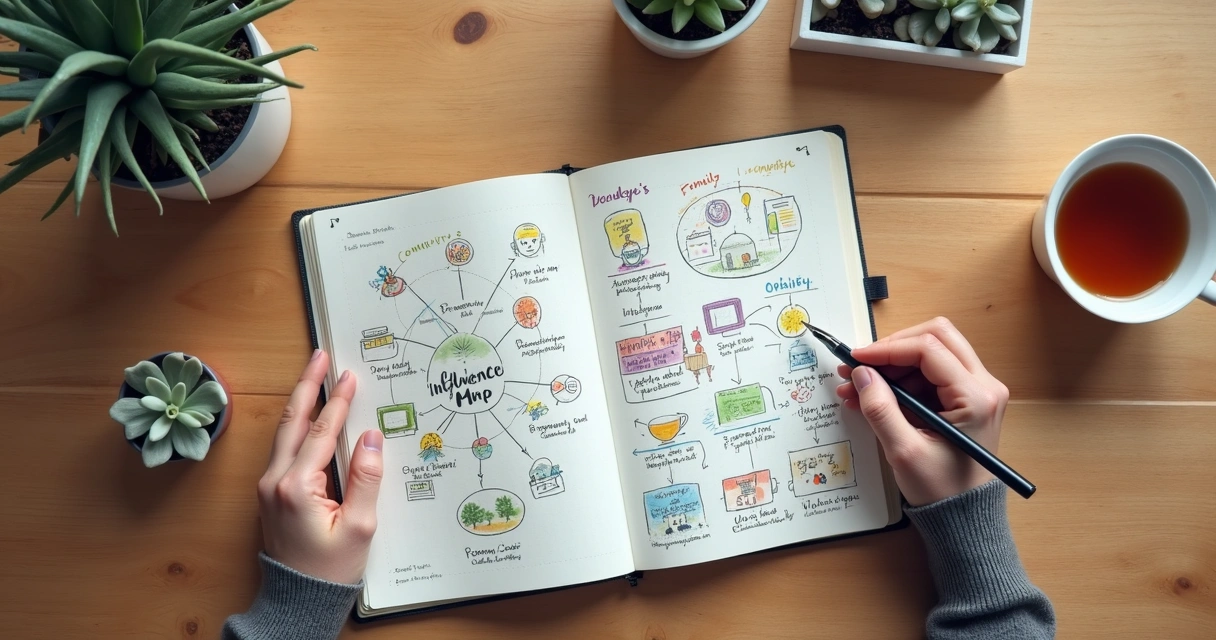
We like to keep this process simple and honest. A map is only useful when it reflects reality, not fantasy. Take a notebook or open a blank document. Then work through the steps below.
Start with your current circles
First, list the main circles where your presence has weight. Do not judge them yet. Just name them.
- Home and family
- Work or business
- Friendships and social groups
- Online spaces
- Community, school, or spiritual settings
One of us once did this exercise and expected work to come first. It did not. The strongest effect was at home, followed by a small professional group. That was humbling. It was also freeing.
Identify where people actually respond
Next, ask where your words, mood, or decisions create movement. Do people seek your view before acting? Do they calm down when you speak? Do they copy your standards? Do they resist you, yet still react strongly to your presence?
Influence is measured by effect, not by intention.
Write down clear signs. Avoid vague claims like “people respect me.” Instead, note what happens in practice.
- People ask for your advice before making a choice.
- Your feedback changes the quality of work.
- Your absence is felt in group balance.
- Your emotional state spreads quickly to others.
These signs reveal where your energy travels.
Separate strong, medium, and weak influence
Not every connection carries the same weight. This is where many maps become blurry. We need levels.
You can divide your map into three zones:
- Strong influence, where your presence changes outcomes fast and often.
- Medium influence, where your voice matters but shares space with others.
- Weak influence, where contact exists but effect is limited or irregular.
This step prevents overreach. It also prevents self-dismissal. Some people think they influence everyone. Some think they influence no one. Both views are distorted.
Notice the direction of your influence
Now ask a harder question. What kind of effect do we bring? Influence is not automatically constructive.
For each circle, note whether your influence tends to create:
- Calm or tension
- Trust or caution
- Action or hesitation
- Clarity or confusion
This is where honesty begins to mature. A person may have strong influence at work but spread anxiety. Another may have quiet influence in a family and create steadiness. Both are powerful. Only one is likely to support better outcomes in 2026.
Map the hidden factors
Good maps go beyond names. They include the forces around each relationship. A practical framework from influence mapping methods described by the Overseas Development Institute suggests looking at positions, motives, and communication channels. We find this useful on a personal level too.
For each person or group, ask:
- What matters to them right now?
- What do they fear losing?
- How do they prefer to receive input?
- What role do they hold in the group?
- Who influences them besides us?
This makes the map more human. Influence is rarely just about what we say. It is also about timing, trust, and emotional distance.

Turn the map into a plan for 2026
Once the map is visible, the next step is choice. We do not need to act everywhere. We need to act where our influence can become cleaner, steadier, and more responsible.
Pick three areas for 2026:
- One area to strengthen, where your positive effect is real but underused.
- One area to repair, where your influence has become tense or unclear.
- One area to reduce, where you are spending energy with little real effect.
A good influence map helps us stop forcing impact where no real opening exists.
This can be uncomfortable. We may find that some spaces only drain us. We may also find that our strongest field of impact is closer, quieter, and more human than we expected.
Conclusion
Mapping your personal sphere of influence for 2026 is an act of maturity. It asks us to look at where we truly affect people, how that effect lands, and what kind of presence we want to become in the coming year.
We think this work matters because influence is always active, even when unnamed. If we map it with honesty, we gain direction. If we ignore it, we still influence, but without awareness.
What we affect, we should understand.
Before 2026 begins, take one hour and draw your map. Keep it simple. Keep it true. That single act can change the way you relate, decide, and lead.
Frequently asked questions
What is a personal sphere of influence?
A personal sphere of influence is the group of people, spaces, and decisions that your actions, words, and emotional presence can shape. It includes both direct influence, such as giving advice, and indirect influence, such as setting the tone in a room.
How do I map my sphere of influence?
Start by listing the main areas of your life, such as home, work, friendships, online spaces, and community. Then identify where people respond to you, divide those areas into strong, medium, and weak influence, and note whether your effect tends to bring calm, trust, action, or confusion.
Why map my sphere of influence for 2026?
Mapping your influence for 2026 helps you enter the year with more clarity about where your energy has real effect. It also helps you avoid scattering attention across spaces where your presence does not create meaningful change.
What tools can help map influence?
A notebook, journal, whiteboard, spreadsheet, or mind map tool can all help. The best tool is the one that lets you see people, relationships, and patterns clearly without making the process too complex.
How often should I update my map?
We suggest reviewing your map every three to six months, or after a major life change. Influence shifts when roles, relationships, goals, or emotional conditions change, so regular updates keep the map accurate.