


Social neuroscience examines how the brain and body support social life, and how relationships and social environments, in turn, shape our responses. For readers interested in psychology, relationships, or collective behavior, its central insight is that connection is not merely an idea: social cues can influence attention, emotion, and coordination, though the evidence does not justify claims that people literally share a mind.
Key insights about relationships and the brain
- Social understanding depends on interacting processes, including attention to others, interpreting emotion, and adjusting behavior.
- People can show coordinated brain activity during interaction, but synchrony is not proof of identical thoughts or deep connection.
- Relationship history and immediate context both matter. A warm conversation, a conflict, and a silent exchange are not equivalent experiences.
- Brain research can inform reflection on relationships, but it cannot replace listening to people or understanding their social conditions.
What does social neuroscience study?
This field investigates how biological processes support social behavior, and how social experience influences those processes. Researchers may study how people recognize expressions, infer another person’s intentions, cooperate, respond to rejection, or coordinate during conversation.
Rather than treating a person as an isolated brain, the discipline connects neural activity with behavior, relationships, and the surrounding environment. That wider view matters because the same pause, glance, or tone can mean different things in different relationships. Research on unspoken signals in relationships offers a useful reminder that social meaning often travels through more than words.
Social neuroscience is interdisciplinary: it draws on neuroscience, psychology, and related fields to ask how social processes work at multiple levels. A brain measure can reveal one part of that process, but it does not by itself explain a person’s full experience or the history behind a relationship.
Relationships engage a network of social processes
Social responses involve coordinated processes, not one dedicated “relationship center” in the brain. Attention, emotion, memory, reward, and the interpretation of another person’s perspective can all contribute as people respond to one another.
For example, eye contact may signal attention, but its meaning depends on context. A familiar partner and a stranger may react differently to the same expression because past experience shapes what they expect. In a study of 104 adults, researchers found brain synchrony during natural interactions between romantic partners, but not during a brief resting period. Among couples, synchrony was associated with moments of social gaze and positive affect, not simply with whether someone was speaking.
These results help explain why social behavior is dynamic. A relationship can change what people notice and how they respond, while each interaction also contributes to the experience of that relationship.
How do researchers observe social interaction?
Researchers combine methods because no single measure captures a whole relationship. Behavioral tasks show what participants do; surveys record their reported experience; physiological measures track responses in the body; and brain imaging or EEG can examine neural activity.
Some studies use “hyperscanning,” which measures brain activity in two or more people at the same time. It allows researchers to compare neural patterns with behavior, such as turn-taking or gaze, but it does not read minds. Social neuroscientists design studies, analyze these measures, and interpret results in light of the research question and its limitations.
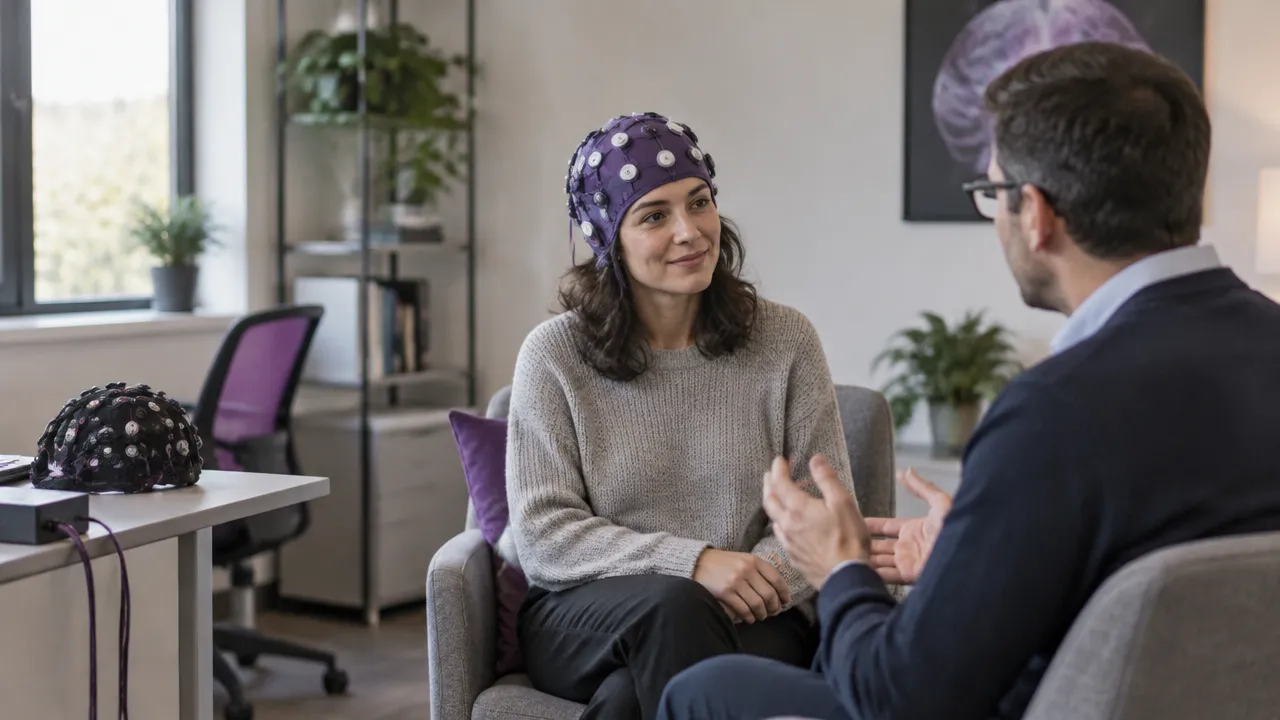
Does brain synchrony mean two people are thinking alike?
No. Neural synchrony describes related patterns in measured brain activity during an interaction. It does not establish that people have the same thoughts, feel the same emotion, or understand each other equally well. Shared attention, movement, or emotional cues may help explain why activity aligns.
Recent experimental evidence offers a useful caution. In a study involving 123 pairs of strangers, a closeness-building conversation increased reported closeness compared with small talk, but did not produce greater brain or movement synchrony. Interacting pairs did show more synchrony than pairs who did not interact. The finding separates two ideas that can be easy to conflate: interaction may coordinate people, while felt closeness does not automatically increase every measure of coordination.
In an earlier study, synchrony among couples was linked with gaze and positive affect during interaction. Read together, these studies suggest that synchrony is a context-sensitive research measure, not a simple score for the strength or quality of a bond.
How can relationships shape emotion and behavior?
Relationships can influence what feels safe, threatening, rewarding, or worth noticing. Over time, repeated patterns of interaction may shape expectations: whether a person anticipates support, prepares for criticism, or feels able to speak openly. These are useful ways to think about social influence, not a claim that every interaction permanently rewires the brain.
The effects can extend beyond close relationships. In a family, workplace, or community, people often adjust to shared emotional norms. If a group rewards curiosity, members may feel more able to raise concerns; if it punishes disagreement, people may learn to stay quiet. Exploring ethical influence within groups helps connect individual responses to the social conditions that encourage them.
This perspective also clarifies why personal responsibility and environment belong in the same conversation. People make choices, but the relationships and expectations surrounding those choices can shape what feels possible.
How can you apply these insights in everyday life?
Neuroscience does not prescribe a perfect relationship. It does support a practical habit: notice how interaction affects your attention and response before assuming you know another person’s intent.
- Pause before reacting, especially when a familiar conflict pattern appears.
- Ask a clarifying question instead of treating a facial expression or silence as proof.
- Notice whether the relationship makes honest conversation safer or harder.
- In groups, consider which norms encourage listening and which discourage people from speaking.
These practices are not a substitute for professional help when relationships involve harm or severe distress. They can, however, support more conscious communication and a clearer view of how repeated interactions affect both people and groups. Self-regulation in group settings can help turn that awareness into more deliberate responses.
Frequently asked questions
What does a social neuroscientist do?
A social neuroscientist studies how the brain and body support social processes such as understanding others, responding to emotion, forming bonds, and navigating groups. They may combine behavioral experiments with brain imaging or physiological measures, then interpret results alongside social context rather than treating brain activity as a complete explanation of behavior.
Can relationships change the brain?
Yes. Relationships can shape how people respond to social cues and coordinate during interaction, while repeated experiences may influence patterns of attention, emotion, and behavior. The effects depend on context and relationship quality. A single study or brain scan cannot show that one person has permanently changed another person's brain.
Does neural synchrony prove that people share thoughts?
No. Neural synchrony means that measured brain activity in two people varies in related ways during an interaction. It does not show that they have identical thoughts, feelings, or intentions. Synchrony can be associated with shared attention or coordinated behavior, and researchers must distinguish these explanations from stronger claims about connection.
What are the three major goals of social neuroscience?
There is no single, universally agreed list of three formal goals. Broadly, the field asks how biological processes support social behavior, how relationships and social environments affect the brain and body, and how these interactions relate to individual and collective outcomes. These questions are studied across levels, from behavior to neural activity.